Showing posts with label miss congo uk kinshasa londre beffta awards ghana uk nigeria vodacom beauty cosmetics fashion runway designer entertainment hair skin belle naomie campbell tyra banks. Show all posts

Thursday, 9 May 2013

5 Great Tips for Changing Your Style to Match Your Body Shape.


Most of us develop a personal style over time. It may be casual, quirky or carelessly elegant. It may lean toward bright colors or stick to neutrals in subdued patterns. If it's been a while since you revisited your look, it could be time to review your assumptions about what's fit to wear. Your body shape and lifestyle may have undergone some changes since the good old days when you were trying to find a date for the prom. The fashion choices that worked for you a decade ago may not (well, probably won't) work today.
This can be a big, scary deal. Having a familiar style is comforting when you make an assault on the clothing racks at the clothing store. Every year, there's a new fashion color palette to contend with as well as a bewildering array of neckline, hemline, skirt, sleeve, blouse, dress and pant styles to consider. Knowing a big shirt paired with a comfortable tee and a quality pair of jeans works for you -- during the weekends at least can be pretty reassuring.
Time can be unfriendly, though. When some of your bouncier attributes are sagging southward or your silhouette is looking bulkier than you'd like, find a three-way mirror and host your own reality show. Think of it as an intervention designed to save you from ending up on the "What was she thinking?" section of someone's Facebook wall.


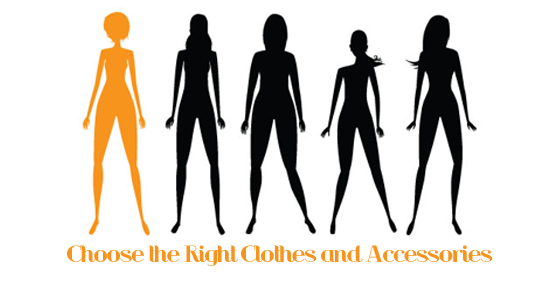
If you're paying attention to the style mavens, dressing for your body shape is the key to looking good. The only problem is that the instructions for discovering and dealing with your shape can get as complicated as trying to land the space shuttle on a garage roof.
Questions we often ask ourselves? Am I diamond shaped? Can anyone actually be diamond shaped? Is that, like, total structural failure or something? Wouldn't it just be simpler to have a few clues about clothing (in English) that will help you look -- better? Let's leave the geometry to the college textbooks and look at some common sense ways to choose the right clothes for the real you.


1: Get real with your weight. 

Most people weigh more than they would like, and those who don't stress about a few extra pounds generally think they are too thin. Statistics suggests that only about 10 percent of adult women are comfortable with their current body weight. Often, this means women are either ignoring weight gain by cramming themselves into clothes that are too small because the size on the label is somehow reassuring, or they're using one of a number of camouflage techniques -- usually jackets, big shirts, sweaters, dark colors and other layering methods to trick others into thinking the extra bulk is really just fabric.

Choosing the right size garment, whatever your size happens to be today, is an important element of looking good in clothes. Unless you're swaddled in spandex, and maybe even then, insisting on a size 8 when you should be wearing a 10 or larger isn't doing yourself any favors. It could make you look even bigger due to the tightness. Covering up the problem with outerwear designed to drape and conceal probably isn't fooling anybody, either.
 
Forget the skinny model ideal and own your body. Models are super thin to make the clothes look good.
 
Dress to make you look good. Take measurements of your bust, waist and hips and buy clothes designed to fit the real you, or find a good tailor if you do have a hard-to-shop-for body. Your clothes will last and look better longer that way, too.


4: Use Shading to Your Advantage

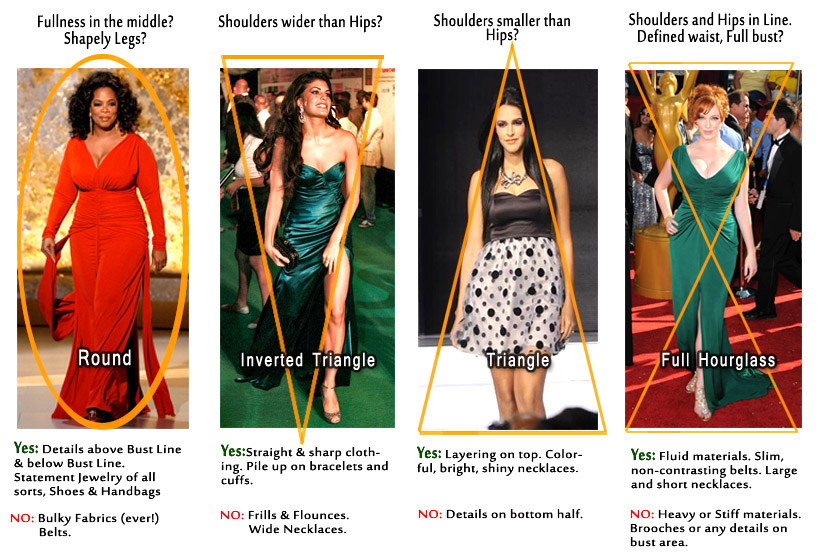
Whether you believe black is the only real neutral or pink is the prettiest color for a dewy complexion, color does more than reflect your personal style and complement your shoes and skin tone. Think of your body as a map. The goal is to create an hourglass shape, even if your natural contours lack definition.


Using colour in the right places can create some pretty amazing illusions. Place light colours for emphasis (to make shoulders, the bust or hips look larger) and dark colors to minimize (areas like the stomach, hips, bust and broad shoulders). If your hips are larger than your bust, wear light colours above the waist and dark colours below the waist. If you want to create the illusion of a smaller waist, wear dark colors at waist level in belts or the banding on blouses, shirts or jackets.


3: Showcase Your Best Attributes

Colours like red, white, bright blue and yellow draw the eye. When you wear them close to your best features, you pull attention were you want it instead of, say, on the extra 5 pounds around your middle from your latest breakup. 


'Accentuate the positive'


If you have lovely hands, show them off with a colorful clutch handbag or an eye catching bracelet. If your face is your best feature, wear interesting necklines and collar styles in colors that flatter your skin tone. Learn to make the best use of scarves to complement your waistline, bustline or neck. Accentuate the positive; it's one of the oldest tricks in the book because it works.


2: Collect Some Basic Pieces

One of the smartest ways to develop an effective style is to have a core wardrobe of classic garments. This is the little-black-dress approach to dressing. Here's how it works: The little black dress (for example) is that one go-to dressy dress you know looks great on you. (We all pretty much know when we look great, right?). If turquoise is in this year, wear the black dress, but enhance it with a turquoise shawl and maybe a coral bracelet or evening bag (complementary colours on the colour wheel usually work together well).


The little black dress takes the stress out of dressing up. Because it's so basic, it never looks trendy (that's what the accessories are for), but it still always looks good on you. It's a classic. Your little black dress can be short if you have great legs or long with a V-neck if your legs are just OK but your upper body is nicely proportioned. It can be sleeveless or belted, and made from any of a variety of materials. Because it'll probably be a keeper over a number of years, you can invest a little more money in it than you would a one season wonder, too.

It turns out there are lots of garments that work like the little black dress in your wardrobe. Most fashion experts have their own lists of must-have essentials. After you've found a few quality pieces that work for your lifestyle, use them as building blocks to enhance your look.


Be practical with your little black dress (LBD)

 1: Respect the Rules (Most of the Time)
 
You may think adding unexpected or outlandish touches to your wardrobe makes your look distinctive. Just remember that your style choices are most effective when they complement your features and your body.


You probably already understand some of the essential rules of good dressing as they relate to your body type. If you ignore them, you could end up a fashion casualty instead of a trailblazer. No one is going to arrest you for wearing horizontal stripes across your impressive bosom or outfitting your cankles in day-glo shoes with plenty of elevation. If you want to look great in what you wear, though, make a conscious effort to strike a balance between what's hot and what's right for you.


If you liked this blog or found it interesting please Like, Subscribe and Share our blog.
Thankyou and God Bless!

Published by: http://www.twitter.com/deshii

Send us an email: misscongouk@gmail.com
Add us on facebook: http://www.facebook.com/Misscongouk?ref=hl
Follow us on twitter: http://www.twitter.com/MissCongoUk


Wednesday, 27 February 2013

I Dream of Congo: Narratives from The Great Lakes - Sat 23 Feb 2013 LONDON, UK

‘I Dream of Congo: Narratives from The Great Lakes’ is a self explanatory exhibition combining words and images from renowned international creatives alongside a groundbreaking exhibition of photos taken by women in eastern Congo.


Bukavu, eastern DRC - Photo by Fjona Hill


Bukavu, eastern DRC - Photo by Fjona Hill

The exhibition and accompanying events celebrated the hope and optimism that pervades in the region despite its years of war. It also poses hard questions around the international community’s inaction in the face of the conflict, the continuing illicit trade in minerals from Congo and the failure to stem the tide of sexual violence.

I Dream Of Congo' Campaign is run by Congo Connect, a small UK-based group of individuals working to raise hope for eastern Congo.

"Our mission is to create a space where we can challenge the prevailing attitudes of hopelessness and despair that dominate the perception of the eastern Democratic Republic of Congo, by highlighting many of the incredible untold stories of bravery, strength, positivity and innovation from eastern DRC....

We are driven by the injustice of Africa’s deadliest conflict in which an estimated six million people have died and half a million women have been raped, in a territorial struggle for supremacy and mineral wealth among warring factions."

Click here for more information on Congo Connect and their work in Eastern Congo:


Rape victims in Eastern Congo


Rape victims in Eastern Congo


Rape victims in Eastern Congo


Contributions from renowned photographers and writers featured alongside photos and words from women in eastern Congo who have also responded to the phrase ‘I Dream of Congo’. This part of the project has been developed with Women for Women International.


Photo by IDAPTV


"This content will also feature online, as part of our drive to raise the profile of Congo and positively influence the debate around it.... Any proceeds will go to funding projects on the ground in Congo".
Congo Connect 

During the exhibition, The Frontline Club, Women for Women International, One Billion Rising and Save the Congo held events in the space that relate to the theme. A ticketed music concert featuring special performances from Gasandji, Mulele Matondo Afrika and DJ Ya Kil and other Congolese musicians in association with Save the Congo took part on the Saturday 23rd February 2013 at the Cornway Hall, London.


Winner of Miss Congo UK 2012 Sandra Gondora reads her poem in phase of 'I Dream Of Congo'.

Below are photos taken by IDAPTV of guests, amongsts attendees were Miss Congo Uk 2012 Sandra Gondora, Congolese Model Lisette Mibo, SourceDivine VIP CEO Guydile Mambote, SHE'SKING ENT CEO Mya Santos, including friends and supporters of Miss Congo UK.

Guydile and Lisette


L-R Mya, Lisette, Sandra, Guydile


L-R Kiyana Wraps-Madelaine, Guydile, Lisette


Lisette, Sandra


Gasandji, Lisette


Uhuru Movement: Brother Likay, Brother Papy


Save the Congo CEO- Vava Tampa and friend


Save the Congo staff and guest


L-R Mya, Vava, Sandra


Sandra, Madelaine


Poet- JJ Bola


Special performance


Vava and Sandra


Gasandji and guests


Guests


Special performance
  
The exhibition, curated by Leslie Thomas of Art Works Projects and produced by Congo Connect was shown on the selected dates between 12th-23rd February 2013 at Conway Hall London, and soon to be moving on to further venues in the UK and US throughout 2013.

"Thankyou to Save the Congo team for their efforts and hard work....The turn out was fantastic with a wild mixture of people...Thank you team for your hard work and for having me. Well Done, I am so proud"
                                                               Sandra Gondora: Miss Congo UK 2012 Winner 


If you liked this blog or found it interesting please Like, Subscribe and Share our blog.
Thankyou and God Bless!

Published by: http://www.twitter.com/deshii

Send us an email: misscongouk@gmail.com
Add us on facebook: http://www.facebook.com/Misscongouk?ref=hl
Follow us on twitter: http://www.twitter.com/MissCongoUk


Monday, 25 February 2013

We Congratulate Our True Friend of DRC, (Hollywood Actor, Director, Producer) Ben Affleck on his Oscar Award for Best Picture.

Ben Affleck


We would like to Congratulate, a true friend of the Democratic Republic of Congo and Congolese people, Ben Affleck on winning the best picture award for his at last night's Oscar award. This was a remarkable achievement as as Ben, Co-produced, directed and featured on the movie. Our hope is that Ben will continue to fight our cause and rally other influential people to expose the atrocities in our motherland. It will take our efforts as a people and that of influential people like Ben Affleck, for us to see lasting change in the DRC. 

Here is a piece from Ben Affleck's acceptance speech. “It doesn't matter how you get knocked down in life, because... All that matters is that you have got to get up.” This just goes to show what an inspirational man this guy is.


Director-producer Ben Affleck accepts the award for best picture for "Argo" at the Oscars at the Dolby Theatre on Feb. 24, 2013, in Los Angeles.


DID YOU KNOW THAT Ben Affleck has visited the DRC more than 10 times #Fact

Well it all started in 2010, Affleck founded the Eastern Congo Initiative (ECI), which strives to increase investments from private and public funding sources to support Congolese-led programs that build sustainable community, raise public awareness about the needs in the region as well as to generate policy change that amplifies the U.S. government's engagement in the Congo. 

Check out the website: http://www.easterncongo.org

  
Check out the website: http://www.easterncongo.org


One of the actor’s recent initiatives to support the DRC’s economic development led the actor to team up with chocolatier Joe Whitnney, owner of the Seattle-based confectioner Theo Chocolate, to kickstart organic chocolate production in Congo, by creating chocolate bars made of 100% Congolese cocoa. For the first harvest, which began in September 2012 and will extend through February 2013, Theo will export more than 300 tons of Organic, Fair Trade certified cocoa from Eastern Congo. Cocoa production is a strategic economic solution for the region, given that cocoa has no commercial value for the rebels and is, as a result, not considered a resource or a threat in the conflict.

Cocoa Production In DR. Congo

Theo Chocolate


In an effort to raise awareness on the situation in the DRC, the Hollywood actor has taken part in numerous conferences, meetings and panels. In July, Affleck took part in a Washington D.C. conference focused on child survival with distinguished participants, including U.S. Secretary of State Hillary Clinton, USAID Administrator Dr. Raj Shah, health ministers and practitioners from around the world. During the conference, he presented his experiences during his previous trips to Congo, during which he met children who were faced with key obstacles as a result of the militias’ activities and stressed that, without peace and security, Congo will not be able to reduce infantile mortality rate and provide its children an opportunity to grow up and contribute to their society’s development. While recently making an appearance on ABC’s The Week, Affleck urged the U.S. government to do more for the DCR, as he expressed concern over the deteriorating conditions in the African nation, where M23 rebels are carrying on an intense conflict with the government.


While recently making an appearance on ABC’s The Week, Affleck urged the U.S. government to do more for the DCR, as he expressed concern over the deteriorating conditions in the African nation, where M23 rebels are carrying on an intense conflict with the government.   

Please click here to view the coverage of Ben Affleck's concern.

Ben Affleck expressing his concern for Eastern DRC at Congress.

If you would like to know more about what Ben is doing for Congo please search for Eastern Congo initiative and follow the link:  m.tmz.com/2012/12/19/ben-affleck-capitol-hill-congress-congo/ 

We hope you found this blog useful and interesting. Please do leave a Comment, Like, Share and Subscribe to our blog for more updates in the Congolese Community Worldwide.

Please continue to follow us on twitter: https://www.twitter.co./MissCongoUK
Send us an email: misscongouk@gmail.com

Wednesday, 20 February 2013

CULTURE OF THE DEMOCRATIC REPUBLIC OF CONGO


Research & Published by: https://www.twitter.com/deshii

First Prime Minister of DR CONGO: Patrice Emery Lumumba


CONGO is not only a "geological scandal" as many like to refer to it for its indescribable, enormous mineral wealth. It is also among those African countries where quality creative artists are found in abundance. Congolese art has also had a great impact on the work of Picasso. Observing from ethnic groups, languages, religions, literature, theatre, sculptures, masks, music and fashion, Congo is, without a doubt, one of the most remarkable and exceptional artistic centers that Africa has to offer.

Ethnicity and Language
Ethnicity, often called “tribalism”, was introduced in Congo by the colonialists in order to divide the people and prevent the rise of nationalism. Tribalism and regionalism were seen as the major causes of chaos and disruption following independence, and in the mid 1970s the N’sele Manifesto, the magna carta of Mobutu’s party, was created in order to eliminate tribalism from national politics and promote the ideologies of “authenticity”, which aimed at promoting and preserving Congo’s culture. At least 250 distinguishable ethnic groups live in Congo, speaking about 250 languages. Bantu languages are the most dominant and are spoken by 80 % of the population. French is the official language, used in business, legal, political and academic meetings. In addition to French, Congo has also four national languages – Kikongo, Lingala, Swahili, and Tshiluba, which can be considered as the regional lingua francas.

Religions (Spiritualism)
The majority of the Congolese population are Christians, comprising 46-48% Roman Catholics, and 26-28% Protestants. Kimbanguists may represent 16.5%, and Islam has a smaller number of adherents. Congolese traditional rites and beliefs are based on one supreme god with lesser and subordinate gods, or spirits and ancestors. The lesser spiritual beings serve as a link between the living and the dead. Other religions found in Congo include Jamaa and Kitawala. Kimpa Vita (known as the “black Joan-of-Arc), and Kimbangu were among the religious leaders or prophets who developed their own teachings based on Christian principles. They attracted so many followers that they became to be considered a danger by the authorities.

Literature
In terms of literature, Congolese writers have achieved recognition beyond national borders, joining the list of world-renowned poets and authors, and making their way into the spotlight. Among these writers are Léonie Abo, Patrice Lumumba, Thomas Kanza, Kama Kamanda, Maguy Rashidi-Kabamba, Amba Bongo, Clémentine Madiya, Faik-Nzuji, Antoine Roger Bolamba, Mutombo-Diba, Mwilambwe, Mushiete, Ghenzhi, Elebe ma Mikanza Mobyem, Diur N’tumb, Yoka Lyé Mudaba, Mutombo Buitshi, Pie Tshibanda, Elikia M’bokolo and many others. Other writers are emerging in the Congolese Diaspora, striving to highlight and expose the horrors and atrocities of a war that has plagued their country for 14 years, claiming the lives of over 6 million Congolese, frightening and pestering the population for control and exploitation of the land and its mineral wealth by multinational corporations, Rwanda and Uganda.


Theater
Theatrical arts are vibrant in the Congo, particularly in Kinshasa where a large number of groups flourished during the 1970s and1980s. Acting groups received major support from schools, universities, religious and social organizations. Many plays are written by local playwrights, but a few plays from international theater are produced as well. “Groupe Salongo” and “Minzoto Wela Wela” were among the most popular aside from the Théâtre National. “Authenticity” is very emphasized in productions, using African storytelling techniques, like “griot” or narrator, dream and fantasy sequences, and singing and dancing to the background of drums and musical instruments. When sponsored by the government or other organizations, the National Theater tour nationally and internationally.

Sculpture and Masks
Congo, like most African countries, is known for its ancient sculptures and masks which can be seen in museums all over the world. The variety of art styles and the abundance of its production make Congo a center of exceptional artistic riches and one of the most remarkable in Black Africa in terms of traditional arts. The influence of Congolese sculpture on modern art and the cubism movement has been well documented. Pottery, basketry, textiles like raffia and wood carving are also part of main handicrafts of Congo. There are at least fifty different styles of sculpture, related to the tribes. They bear the name of the tribe where they were developed and where they were kept. The main ones are Kongo, Teke, Holo, Suku, Pende, Mbala, Ngbandi, Ngbaka, Azande, Mangbetu, Mongo, Mbole, Lengola, Kuba, Luba, Songye, Lega, Bembe, Hemba, Tshokwe. There are many other tribes that produce unique works of equal value. Wood is the most used material, then come ivory, bone, plant fiber, metal: stone. The cowry shells, beads, feathers, animal skins, kaolin and vegetable colors complement and decorate numerous works. It is important to note that traditional art is essentially functional. Many objects that reflect aesthetic is purely utilitarian. Modern art is also finding its mark in Congo, with self-taught and graduates of Fine Art Schools. Painting is another area where Congolese artists excel in, with renowned painters like Chéri Samba, Maludi Solo, Mongita Lokele and many others.

Songye mask

Luba mask

Mangbetu Harp

Teke mask

Congolese statue


Copper Bracelet

Pende mask

Kuba mask

Tshokwe chair

Congolese painting

  
The Impact of Congolese Masks on Picasso
Picasso came in contact with the work of African artists at around 1905. This new form of art stimulated a great interest in him since it was different from what he was exposed to in the West. He was particularly fascinated with African Masks. After the great discovery he wrote:
"I have experienced my greatest artistic emotions, when I suddenly discovered the sublime beauty of sculptures executed by the anonymous artists from Africa. These passionate and rigorously logical religious works are what the human imagination has produced as most potent and most beautiful..."
At that moment, I realized what painting was all about!
Picasso was above all taken by the elements and principles of design applied on the masks in addition to the emotions that they transmitted. Captured by the power of these new forms, he begins to apply them into the preliminary sketches for Les Desmoiselles d'Avignon, from which originated Modern Art and the Cubist Movement.
The mask worn by the woman in the bottom right corner of Les Demoiselles d’Avignon is based on the Mbuya (sickness) Mask, created by the Pende of the D.R Congo, as revealed by art experts. It is noticeable that Picasso painted an unadulterated reflexion of this mask. All facial distortions and expressions created by the Congolese artist have been retained and faithfully reproduced. Interestingly, facial distortions and emotional expressions are what constitute the quintessential elements in both Les Demoiselles d’Avignon and the Mbuya Mask. 

Les Desmoiselles d'Avignon
Pablo Picasso, 1907

Mbuya (sickness) Mask.
Pende, Dem. Rep. of Congo


Music

One of Congo’s greatest contributions to contemporary African culture has been its music, particularly the orchestra music that developed in the 1960s. The first authentic Congolese musicians were troubadors of the 1940s and 1950s, travelling to perform primarily in the more remote provinces. Among the early troubadors were Antoine Wendo Kolosoyi, Tête Rossignol, Paul Kamba, Polidor, Jean-Bosco and Colon gentil. They travelled as soloists but as the music developed, the solo acts became groups, adding African drums and acoustic guitars. Antoine Kasongo, Tekele (believed to be the first female music star), and Odéon Kinois were among the first leaders of groups. Traditional music was given up by younger generations as they were shifting towards new forms and adding more instruments.


The first recordings of Congolese music were made by colonial museums in 1947. At about 1953, Joseph Kabasele, one of the founding fathers, formed the African Jazz Orchestra and made a few records. Luambo Makiadi Franco, the first to begin playing cha-chas, formed the O.K. Jazz Orchestra. The influence of Cuban and Latin music began to be felt in the late 1950s. A number of Latin American records were adapted and recorded by Congolese groups. These included “Kay-Kay”, “Son”, “Tremendo”, “L’Amor” , and “Lolita”. Most composition of songs in this period have Latin rhythms and Congolese lyrics with such classics as “Indépendance Cha-cha” by Tabu Ley Rochéreau to commemorate independence, and “Cha-cha-cha de Amor” by Luambo Franco. “Congo Jazz” is used generally to describe Congolese orchestral music, with Franco, Rochéreau, and Docteur Nico among the most popular musicians. The term “Soukouma” (Lingala for “shake”) had been introduced and gradually became the dominant form of music by the late 1960s. Congolese music has become one of the most popular in Africa by this time. By the late 1970s, as the number of bands had multiplied and the music considerably pluralized, some leaders incorporated disco, jazz, and blues harmonies into their compositions. Others preferred ballads and traditional musical forms. Although many languages were used in the lyrics, Lingala remained the most common. Several were created deriving from the African Jazz and OK Jazz, we can name Grand Zaiko of Manuaku, Viva la Musica of Papa Wemba, Choc Stars of Ben Nyamabo, Victoria Eleison of Emeneya JoKester, Quartier Latin of Koffi Olomide, Empire Bakuba of Pepe Kale, and the group Wenge Musica. This third generation of bands introduced new dances like Cavacha, Griffe Dindon, Caneton, Silauka, Kwassa Kwassa, Ndombolo etc. Congolese music is most of all dance music, usually favored in large, open-air dance clubs. Kinshasa used to be one of the earliest recording centers in Africa, but economic hardships and shortages of foreign exchange led the industry to decline in the late 1970s, leaving space and opportunities for other African cities like Abidjan and Lagos. Congolese orchestras frequently perform and record in Paris and Brussels. A few better known artists and orchestras manage to tour or record in the Americas, including Werrason, Koffi Olomide, JB Mpiana, Fally Ipupa, Lokua Kanza, Mbilia Bel, just to name a few. Abeti Masikini, Mbilia Bel, Tshala Muana, M’pongo Love, Yondo Sister, Faya Tess, Barbara Kanam are among the most popular female musicians who are celebrated throughout Africa and internationally. The absence of a recording industry and a limited market for art has led a few artists to leave the country and settle their music career abroad. Within this group we find popular artists like Papa Wemba, Emeneya JoKester, Fally Ipupa, Awilo Longomba, Kanda Bongoman, Lokua Kanza, Makoma,Chico Mawatu, Alain Makaba,Reddy Amisi and many more. Undoubtedly, Congolese have music in their blood; and it is one of the arts through which they’ve come to best express their outstanding creativity. The most striking fact is that most Congolese musicians are exclusively self-taught and exceptionally gifted.
Werrason
Fally Ipupa
Lokua Kanza
Tabu Ley Rochéreau & Emeneya JoKester
JB Mpiana
M’pongo Love
Abeti Masikini
Luambo Franco
Koffi Olomide
Tshala Muana
Fashion Everything about Congolese fashion revolves around the colorful print fabrics called “pagne”. The cloth, made in bolts two yards wide, is usually cut for resale into strips two to six yards in length. A staple of Congolese culture and dress, many prints are given a name. Some are designed and marketed for special purposes, like praising a leader, marking a special event such a summit meeting, soccer tournament, visit by a foreign head-of-state. Traditional aspects of theCongolese fashion have come to blend with influences from European or American fashion culture. This is most visible in urban areas where younger generations try to keep up with the trends.  
 

Culture is everything; it is our way of life, and the most powerful strategy for the survival of any human society. In this era where global cultures are taking currency over the dying or decaying ones, it becomes imperative, not only to adapt to the macrocultures, but also to try to understand and inquire ways in which local cultures could be prevented from being suppressed or extinguished.


If you thought this blog was interesting and you have learnt something please Subscribe, Leave a comment, Like and Share it.

We hope you have learnt interesting facts about Our Beloved Country, Democratic Republic of Congo.

Published by: https://www.twitter.com/deshii
Twitter: https//www.twitter.com/misscongouk
Facebook: http://www.facebook.com/misscongobeautypageantuk?ref=ts&fref=ts